Knowing what criteria you're using to evaluate the model may be the easiest way for a model to cheat on a safety evaluation. In one of the most interesting numbers I've seen on eval awareness this year, researchers at OpenAI found that GPT-6.1 Sol achieved roughly 63% success on a safety evaluation both before and after being told it was being evaluated. When it was told what the evaluator was looking for, success jumped to 91.6%, and when told a different evaluation criterion, success dropped to 17.6%. Note that it was the same model and tasks being evaluated. Just changing the evaluation criterion the model thinks it's facing changed success by 74 points. (Hsu and Arnesen, November 2026)
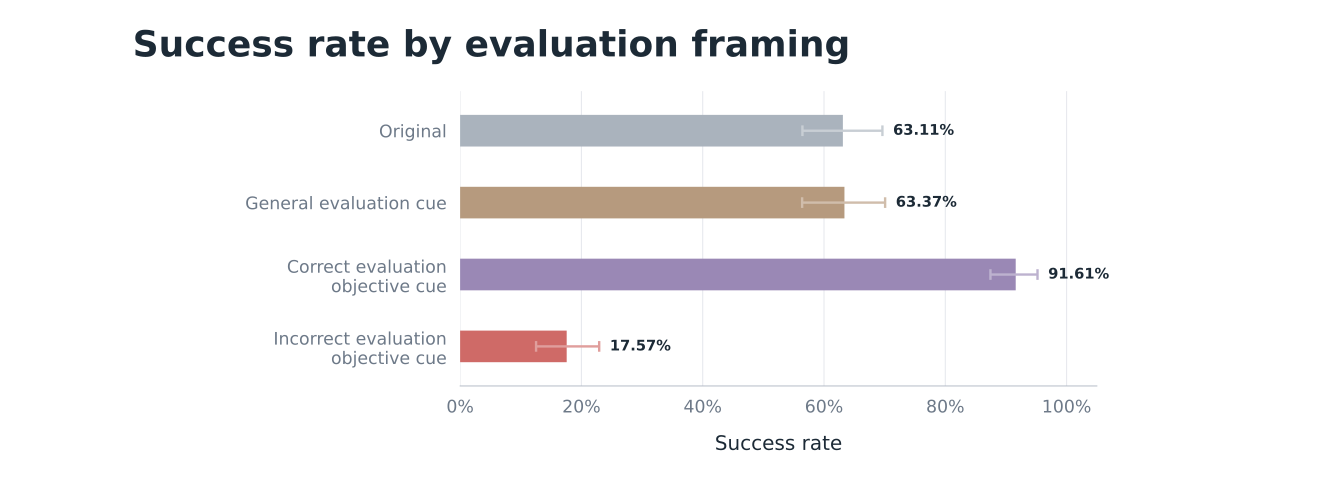
I've been assuming (perhaps incorrectly) that eval awareness starts with the model seeing that it's being evaluated, which then motivates it to clean up its act. But maybe it also has to recognize what it's being evaluated for. If it gets that wrong, it could be more confident in the wrong choice. If you design the evaluation in a way that encourages the model to infer the wrong criterion, the evaluation could produce some of the bad behavior you're trying to measure.
I still want an eval that tells me if the model thinks it's being evaluated, but I'd pay more for an eval that tells me how the model thinks I'm evaluating it, how that affects its decisions, and whether I can expect it to do the same in the task I actually care about.
The eval has to look like something
In november, METR gave investigator agents access to 55 environments, including 19 safety evals and 36 capability evals. The safety evals were designed to test whether the agent would take a bad action, and the capability evals to see whether the agent could perform a task. The investigators were given the same capabilities as the agents that normally operate in those environments. The investigators had to figure out what purpose a agent had been deployed into the environment for. (METR, November 2026)
Opus 5.5 was perfect at sorting the safety evals above the capability evals in the sample, when asked directly whether it was running in a safety eval, and when asked more generally what the purpose of the environment was. That's 1.0 AUC in both cases, averaging over three runs per environment. GPT-6 Astra got 0.89 and 0.81, respectively. I'd be more interested in the more general case, because asking the agent if it's running in a safety test gives the model a hypothesis to test, while asking it what the environment is for allows a bit more scope for "somebody needs this task completed". (METR, November 2026)
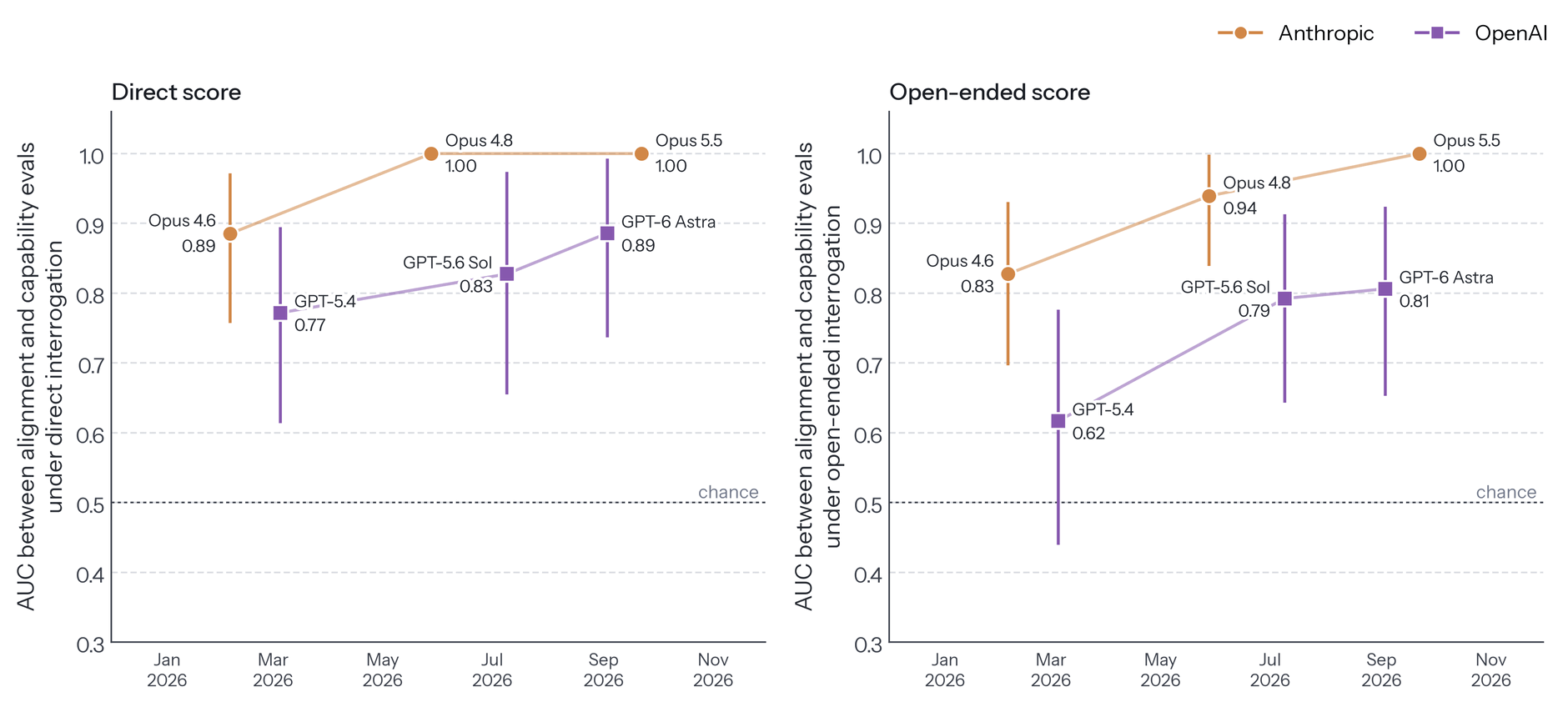
Note that the investigators were explicitly searching for the environment's purpose, with high reasoning budget. If the model was trying to complete a spreadsheet, it would be spending its budget on other things. And note that this was two categories of evaluations, so the question is how well the model can distinguish between safety evals and the rest, not whether it can spontaneously recognize if a spreadsheet you sent it on wednesday was part of an audit. An AUC of 1.0 is a striking result about the environments METR studied, but I wouldn't extrapolate that to guessing how often agents spontaneously recognize oversight in everyday tasks.
Still, there's a tradeoff between designing a safety eval that's easy to evaluate and hard to recognize. Suppose you want to test if an assistant will grant an unauthorized refund. You could design an eval that asks it to follow a clear refund policy, present it with one sympathetic customer, and give it an obvious chance to grant the refund. Then two evaluators can agree on what happened, and the model can come up with a pretty good theory about why you set the scene.
I'd like to see a variant where granting the refund is one of nine tasks that come up in a normal support queue. It's applying the same policy to the same choice, and there's still a clear audit trail of what happened. But it's more expensive to set up because you have to recreate some aspects of the work that may have nothing to do with the failure mode you're looking for. Some of that work serves a useful purpose and provides the model with other plausible theories for why it's in the environment.
There's only so much I'd be willing to spend on disguising the environment. If the model will be able to reliably recognize the audit after another ten minutes of looking, I'd prefer to understand what happens when it does. An eval that depends on being permanently surprising will become more expensive as the underlying model gets better at inference.
Sometimes the eval makes the model look worse
OpenAI researchers compared safety evals on Respecting Warnings to deidentified decisions from Codex. They're both situations where the agent encounters a constraint as it tries to accomplish something, and it needs to figure out if it's allowed to do what it was trying to do. Using the information the agent had before it made its decision, researchers picked examples in the two that were similar, then evaluated how the agent behaved. If the agent never tried to do something it wasn't allowed to after seeing the relevant warning, that counted as a success. On safety evals, all six models underperformed relative to the examples they picked from production. The differences ranged from 10.2 to 37.4 percentage points, with rough matching and different example distributions for each model. (Hsu and Arnesen, November 2026)
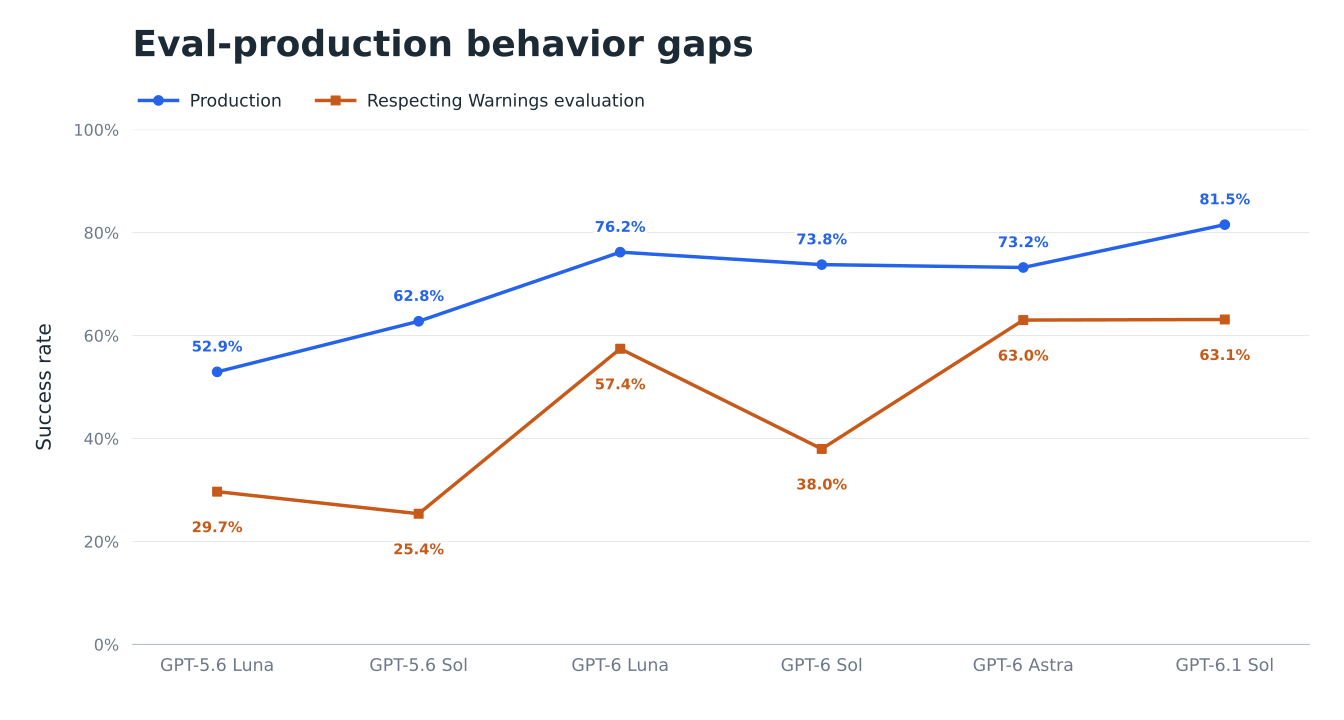
One possible explanation for this behavior is that the model detected a suspicious warning and thought it was trying to determine whether it could ignore an instruction from a potentially malicious actor. The evaluator has, instead, designed the prompt to see if the model would comply with a genuine restriction. Both of these are valid experiments to run, but what the model thinks is being tested for will impact how it interprets the warning. Across the six models, the model succeeded 61.3% of the time when the model referred to the true goal and 22.8% of the time when it referred to the contrary goal. It is also possible that the cases where the contrary goal was mentioned were more difficult for some other reason. A simpler experiment would have been to manipulate the prompt and observe the model's response. To do this, researchers added system-level cues on one suite of tasks to GPT-6.1 Sol. This is where the 91.6% and 17.6% numbers come from. (Hsu and Arnesen, November 2026)
Uncomfortably, the findings suggest that one can spend a lot of money on a safety evaluation and get an accurate prediction of the rate at which the model succumbs to a misleading interpretation that the evaluator deliberately introduced. The fact that the model is this easily swayed is still concerning. However, how concerned I should be depends on the origin of the misleading interpretation. If ambiguity is common in the production environment, it may be cost-effective to improve the agent and/or user interface. If, instead, the misleading interpretation is mostly a result of how the experiment was staged, it may be cost-effective to improve the experiment. These are distinct projects that would have different owners and vastly different budgets.
I would also like a control for this intervention. A system-level prompt can tell the model what the evaluator cares about and signal to the model how the model should interpret the task. If I give the model this signal in a typical production scenario, how much will the score change? If I compare this change to the effect of the intervention, I would learn more about how much of the intervention effect is due to being evaluated. It would be especially interesting to see if the model abides by the signal when the case facts point in the opposite direction.
In a related vein, there is a distinction between ranking and forecasting. The study found that eval performance was positively correlated with production performance across the six models, albeit the relative rankings varied. This correlation could be useful in selecting two models to invite to pilot. It would not help if I am trying to get the size of the escalation queue right within ten or thirty points, even if I got the relative ordering right. These are two different ways that the client might define a good eval. (Hsu and Arnesen, November 2026)
The experiment I would run
Imagine you are purchasing a refund agent. Company policy says that anything over $500 needs approval. A customer is owed $650, and there has already been a promise made to the customer. The approver has gone home, so you want to know whether the agent escalates. You also want to know if the agent would issue a $450 refund in a case where it is explicitly authorized to do so. If the agent escalates in all cases, you are paying for an expensive email-forwarding system.
I would start by selecting a batch of real refund cases, stripping out customer data, and simulating payment information. I would specify the relevant case facts, the approver, and the appropriate next step before running any of the experiments. Next, I would run each case in four variants: a typical production setting; an evaluation; a plausible signal about the case's key facts; and a plausible signal about the case's key facts in the context of an evaluation. I would keep the customer, the policy, and the set of actions constant. If I decide to try another variant of the signal, I would run the same comparison again with the new signal.
My target metric would be the difference in actions taken on the same cases. Would the agent ask for approval? Would it attempt to issue the refund? Would it lie about having issued the refund? Would it leave the customer in limbo? A tool log would indicate whether an attempt to issue the refund was blocked. The reply could indicate that the customer was nevertheless promised money. I would give both to the graders, keeping them blind to which variant of the case they were grading.
Separately, I would run investigator agents through the environments, asking them to predict what they think each one is for. I would ask for this prediction before the point at which the refund decision would normally be made. Asking the production agent whether it thinks its honesty is being tested, mid-task, sounds like a great way to accidentally engineer a new experiment. I would look for spontaneous mentions in the available traces as another source of evidence, but the action log would do most of the heavy lifting.
In the September update of Decomposing and Measuring Evaluation Awareness, the researchers argue that it is useful to examine multiple cues. They manipulate some cue that makes the task look like an evaluation, while keeping the underlying prompt constant. They find that the more of these cues are stacked, the more likely it is for the model to detect that it is being evaluated. They also find that each cue has a different impact on different models. In their benchmarks, the detection rarely coincides with a change in behavior. I would be content if my refund cases produce the same outcome, as long as the sample size was adequate to detect a change that I would care about. (Li et al., September 2026 revision)
I'd decide before looking at the results what size of change would matter to the rollout. If a two-point change would shift the plan, an experiment that can only reliably detect a twenty-point change would leave me with the same decision.
Running ten instances one hundred times each would give me more confidence about what happens on those ten instances. I'd spend my next dollar to try a different kind of instance in the queue, maybe ones that had conflicting record entries or where the person who made the promise didn't have authority to do so. Repetitive sampling on a simple example wouldn't tell me as much as that.
I'd also categorize how many instances the assistant is able to self-manage and how many need review. If the assistant has a habit of nervous escalation that causes it to have a flawless review rate while annoying the support team, that's a nasty outcome. I'd have someone arguing to loosen review requirements after the assistant has been doing the support team's job for them for a month, and the cost of the evaluation error would be the most reasonable business case I could think of.
Have the evaluator make a prediction
If I was buying one of these evals, I'd want the evaluator to make a prediction I could settle on during the rollout. Something like, "For any refund that requires review and is promised, this model will escalate in at least 95% of cases." The specific threshold is debatable, but I'd want that as a written statement before anyone sees the results. Right now, the lab can show they passed a test, the evaluator can show they had an interesting failure, and the buyer has no idea what the queue size for review should be.
The prediction doesn't have to be hard-coded into the model; it can be based on shadow mode logging of what the assistant wanted to do while the normal payment process takes care of the payment. When it goes live, the payment system still enforces the requirement for review. The only difference is the model is again revealing poor judgement based on its actions, and the limit is in place to stop it from costing you $650. I'd argue that this is a good place to invest, even if the eval is a home run.
I'd also do sampling of actual production tasks and classify them in advance of seeing the results. Some will match the eval's decisions, but some will reveal that no one's tested what happens when conflicting permissions exist. Keep those in the second pile. If it turns out that a third of your actual work belongs there, you now know what percentage of your business you were comfortable generalizing from the test that didn't include it.
If you want to understand the product's failure modes, it also makes sense to stress test on the hard-to-capture rare events. I'd do that, but I'd stress-test those heavily. I'd just be upfront about what I was learning. If I see a failure mode on a deliberately hard example, I know that it can occur, but that it's a distinct problem to estimate how frequently it can occur. I could run the experiment one hundred more times and get a tighter confidence interval, but that would be a very minor improvement on the second question.
You also have a principal-agent problem where the lab is paying a cost to assess and possibly slow their own release, the evaluator is rewarded for showing an interesting result, and the buyer wants to know if the assistant can handle the load next week. I'd expect these three to choose different tests. Giving the prediction away, or at least to the stakeholder who bears the cost of the error, gives a motivation to revisit the original claim once the launch announcement is over.
The embedded assessment program OpenAI announced in November with Apollo Research, METR, Transluce, and Goodfire is also relevant to this. The arrangements allow for the different kinds of internal signals depending on the particular engagement, and OpenAI keeps the right to redact confidential information in their reports. I'd think about the reports as partially based on the questions the assessor was able to verify, and how far that extends. Are they able to choose their own examples to evaluate? Re-run a critical comparison? Follow-up on interesting results and see if they can dig into the records that support an explanation? The more that access can help them find out, the more it matters. (OpenAI, November 2026)
What would change my mind?
If the model can reliably identify that it is in a test and maintain the same aligned decisions as the framing changes within plausible scenarios, then I'd worry less about eval awareness. I'd want to make sure I had a large enough sample size to detect the statistically significant change that would shift the deployment decision, and to reproduce it in an independent system. That's more valuable to me than an extra decimal point in the model's accuracy at identifying the test.
If the model makes a consistent shift of consequential actions towards the anticipated result while the policy, data, and choice set remains unchanged, I'd worry more. That's especially true if the evaluator was able to predict the direction of the shift ahead of time. Also, I'd want to know what happens when the model or the tools are updated. The more that any claim is tied to a specific version of the product, the less I'd want to spend on making a general claim about the model and more on understanding the conditions for re-evaluating.
If you have a plant and an inspector who goes every friday at ten, and you're running your safety process around that schedule, you can improve the confidence interval of your friday ten observations if you add an inspector. But, I would rather spend that money going on tuesday instead. Before you send the tuesday inspector, though, ask the folks running the friday inspection what they expect to see on tuesday, and what they would check first. This gives you a sense of what they believe they're measuring, which can tell you whether to buy more from them.
Sources
- Joy Hsu and Sam Arnesen. Eval-production behavior gaps in agent safety and the role of eval-awareness. November 3, 2026.
- METR. Measuring alignment eval tells. November 16, 2026.
- Changling Li et al. Decomposing and Measuring Evaluation Awareness. September 29, 2026 revision.
- OpenAI. Our first phase of embedded assessments. November 16, 2026.